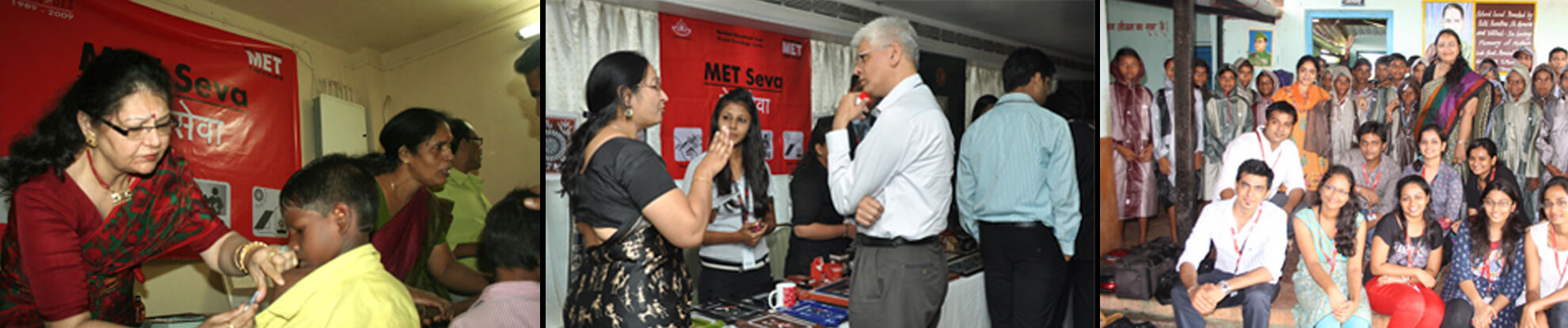
MET was granted 'NGO in Special Consultative Status with the Economic and Social Council of the United Nations' at its session in July 2003 at New York. Ever since MET has undertaken number of activities to promote the developmental goals, including those contained in the Millennium Declaration. These activities are undertaken by MET in support of the MDGs and the work of the United Nations, with a special focus on the use of ICTs through a partnership project on implementation of the Paperless Committee project for the committee on NGOs now adopted as a normal mode of operation.
| S.n | Month / Year | Activities |
|---|---|---|
| 1 | Mar-03 | Workshop on Building Partnerships towards Achieving Development Goals in India |
| 2 | April/ May/ June 2003 | 9 students of MET visited to UN-ECOSOC for three months for the Paperless Committee Project-1st Mission |
| 3 | Dec-03 | - 2 students of MET visited to UN-ECOSOC for two months for the Paperless Committee Project - |
| 4 | - January 2004 | 2nd Mission |
| 5 | April/ May/ June | - 2 students of MET visited to UN-ECOSOC for three months for the Paperless Committee Project - |
| 6 | 2004 | 3rd Mission |
| 7 | November/ December 2003/ | -4 students of MET visited to UN-ECOSOC for three months for the PaperlessCommittee Project - |
| 8 | Jan-04 | 4th Mission |
| 9 | April / May / June 2005 | - 4 students of MET visited to UN-ECOSOC for three months for the Paperless Committee Project - |
| 10 | 5th Mission |
Highlights of Project-TRUTH (Total Rural Upliftment Through Holistic Care)
MET has been working in the areas of academic excellence as well as seeking public participation in fulfillment of the Millennium Development Goals (MDG) in rural areas. Besides providing academic inputs to the students it is working with the indigenous people in the rural areas of India. We have been sharing our inputs with number of NGOs working in the area so that synergy is developed through partnership and networking.
While reviewing the participation of MET in direct interface with the indigenous people, we have gained valuable insights into the operational aspects of rural development programmes especially the MDGs. Some of these insights may have not merely regional or national connotation, but they may be viewed as globally relevant keeping in view the global dimension of the MDGs. We would like to share some of these with the High Level Segment.
The first learning concerns the programme formulation, conceptualisation and implementation. After preparing a programme outline in consultation with experts from UN-ECOSOC NGO Interregional Adviser, when we actually took it to the indigenous people, we found that prima-facie there was over all acceptance of the project content. However, as individual areas were being discussed, the beneficiaries appeared to have developed a notion that the programme was an extension of parallel government funded initiatives, which involved mere dolling out of funds. There was no commitment to the outcomes as well as corresponding benefits to the recipients. The popular participation in the government initiatives was insignificant which eventually affected the outcome. But we clarified that the MDG initiatives were totally public participation driven and would be implemented only after popular commitment was total.
As a result of this learning, we have focused on setting up of Self Directed Work Teams (SDWT), which consist of indigenous people beneficiaries from each settlement who form the core team of the programme implementers. These teams are then trained about the relevant aspects of the MDG programme and networking. They in turn carry the message to the rest of the indigenous people beneficiaries to seek their total commitment and participation. Where necessary the programme format is suitably altered and priorities are re-worked to ensure popular participation and total commitment.
These SDWT members are then involved insetting up of pilot projects, which form the core of the Self Employment Projects proposed to be implemented for the poverty eradication under the MDGs. This has proved to be a success as we have been able to establish successful pilots in the programme area with participation of indigenous people in goat/ sheep breeding, pisciculture, diary farming, water harvesting, etc. The SDWT members acted as a nucleus around which other indigenous people could be brought together to ensure popular participation.
The second most important learning which we would like to share is the lateral participation of small business enterprises in the poverty alleviation programmes to motivate popular indigenous people participation. While organising indigenous people to participate in market driven handicraft production, we found that the participation improved substantially when local traders who buy large number of bamboo products including woven bamboo boxes directly talked to the indigenous people for supplies. This motivated the indigenous people to show interest in the bamboo products training centre which is being set up with the help of the local state agency. The local interest was triggered only when the traders asked for the baskets since it convinced the indigenous people that there was existing market for their product. Thus participation of local small business community in poverty alleviation programmes has great impact in making the project a success.
The third most important learning of the indigenous people participation programme is that initiatially women participants may not be forthcoming to participate in poverty alleviation efforts. But once the initial doubts are cleared, then it is the women who drive these programmes to success. They totally overtake the male participants as well as out number and out perform them through their dedication, hard work and total commitment. The pilot initiatives launched by SDWT initially had larger male participation but eventually they are being run and made a success by the female participants all the way.
As may be seen, MET has been active in providing manpower and intellectual support directly as well as indirectly to further the cause of UN-ECOSOC and help in implementation of the Millennium Development programme. In this task Met has been seeking collaborative support, participation and partnerships from other NGOs working in the project area as well as number of voluntary and civic action groups in the region. This partnership is further widened with the support of international bodies like UN DESA which help to provide global connectivity. The Project-TRUTH conceived and developed by MET, is now being sharpened and actual work plan is being evolved so as to ensure mass participation of the beneficiaries of the Waliv Tribal area. Thus though the plan is centrally conceived, it is being fine-tuned to meet local aspiration challenges through lateral and multi-dimensional partnerships with the full participation from beneficiaries.
Through the learnings we are focusing on forming up of the SDWTs and bringing the women folk in making these a success. Thus the ultimate goal of the project is to seek poverty alleviation (MDG1) through promotion of gender equality and women empowerment (MDG3). The indigenous people are responding to the programme but obviously the pace is slow as rushing through will not help popular participation. Hence we shall be implementing the MDGs to seek poverty alleviation with full participation of the weakest sections of the society and indigenous people, involving multistakeholder partnership government, civil society, corporation, foundation, etc and local authorities.
| Month / Year | Activities | Remark |
|---|---|---|
| 2003/ 2004/ | Paperless Committee Project at UN-ECOSOC | Enclosure 'I' |
| 2005 | ||
| April/ May/ June | - 9 students of MET visited to UN-ECOSOC for three months for the Paperless Committee Project - | - |
| 2003 | 1st Mission | |
| Dec-03 | - 2 students of MET visited to UN-ECOSOC for two months for the Paperless Committee Project - | - |
| - January 2004 | 2nd Mission | - |
| April/ May/ June | - 2 students of MET visited to UN-ECOSOC for three months for the Paperless Committee Project - | - |
| 2004 | 3rd Mission | - |
| November/ December 2003/ | - 4 students of MET visited to UN-ECOSOC for three months for the Paperless Committee Project - | - |
| Jan-04 | 4th Mission | - |
| April / May / June 2005 | - 4 students of MET visited to UN-ECOSOC for three months for the Paperless Committee Project - | - |
| 5th Mission | - | |
| 2003/ 2004/2005 | Project - TRUTH (Total Rural Upliftment Through Holistic-Care) at UN-ECOSOC | - |
| Mar-03 | Workshop on Building Partnerships towards Achieving Development Goals in India | - |
| Oct-03 | Project-TRUTH - Prepared draft Project Report in consultation with Najet Karaborni - Senior Interregional Adviser in Governance, Dept. of Economic and Social Affairs | - |
| Oct-03 | Bench mark survey for need assessment of Tribals and finalisation of draft plan for implementation | - |
| May/ June 2004 | Launching Pilot programme (under Project-TRUTH Planning Matrix) Promotion of Self Employment Projects - setting up of pilot model goat/ sheep breeding projects in Waliv area. Setting up of pilot model Diary demonstrations production projects. As well as Warli Tribal Art and Culture programme at Waliv. | - |
| May/ April 2005 | Setting up of site office and formation of Self Directed Work Team (SDWT) for mobilising local participation and project formulation and implementation | - |
| May/ April 2005 | Setting up of pilot sweet water pisciculture demonstration model in project area | - |


©Mumbai Educational Trust, All rights reserved | Last Modified Date: Tuesday, June 9th, 2026
