
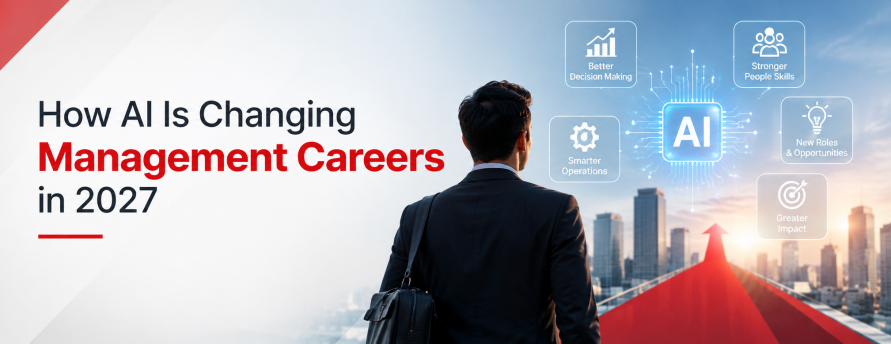
Artificial intelligence (AI) has changed how organisations function and make choices about how to run businesses and
how they handle employees. By 2027, AI will no longer be used only for technical jobs. AI will become a major
component of marketing,
finance,
human
resources, operations,
analytics and strategy
development.
For professionals looking to move into management positions, having knowledge of what Artificial Intelligence (AI)
can do for businesses and being able to use it to solve problems will be a key factor in their success as they
develop professionally.
AI and the Changing Role of Managers
AI can replace many repetitive tasks, like analysing data, creating reports, conducting studies to learn about
customers and writing new material for your website. By replacing these types of jobs with AI, managers will have
more time to focus on what they do best: developing long-term plans for the organisation, solving complex problems,
innovating and being leaders.
While AI can assist in decision-making, it cannot replace the manager’s role in evaluating data, understanding how
the business works, managing employees and making informed decisions. As such, the ability to combine AI with
managerial decision-making will become more and more important as time goes on.
The future workforce will need to have a number of key skills; some of these include analytical thinking, creative
thinking, leadership and flexibility. These are in addition to the growing importance of AI and big data, which were
identified as being the fastest-growing skill area by the World Economic Forum's Future of Jobs Report 2025.
Skills Future Managers Need
Management professionals entering the workplace in 2027 should acquire a mix of technical and professional (business) abilities, such as:
- AI and digital literacy
- Data-driven decision-making
- Strategic and analytical thinking
- Communication and leadership
- Creative problem-solving
- Adaptability and continuous learning
Professionals who are able to apply their knowledge of these skills will have a better chance at being successful within the workplace as AI becomes more integrated into daily operations.
AI Across Management Functions
AI is being utilised in many aspects of business management. Marketing professionals are using AI to gain insight
into customers' behaviour as well as to evaluate the success of their campaigns; financial analysts are utilising AI
to predict future performance and assess risk; human resources managers are using AI to track employee productivity
and trends; and operations professionals may employ AI to optimise processes and predict demand.
The relevance of artificial intelligence (AI) awareness is independent of the student's area of concentration within
their management degree programme.
Preparing for AI-Enabled Management Careers
MET Institute of PGDM
prepares students to navigate an evolving business environment by combining management
fundamentals with practical and industry-oriented learning. As AI becomes increasingly integrated into business
functions, developing skills in areas such as analytics, strategic thinking, problem-solving and technology can help
students understand and respond to emerging management challenges.
MET Institute of Management reflects the
changing nature of management education by focusing on the knowledge and
skills required to work in dynamic business environments. With technology, data and AI influencing organisational
decision-making, students can benefit from developing a broader understanding of how emerging technologies are
shaping business strategies, workplace practices and future career opportunities.
MET Asian Management Development
Centre prepares students to succeed in the rapidly changing creative and digital
career markets. As technology and innovation continue to evolve the operations of various industries, students need
to develop both their creative skills and an understanding of the impact of emerging technologies. The use of
artificial intelligence in design, media and digital communications will require students to learn how to utilise
these new tools and techniques so that they are able to adjust to the constantly evolving professional
environment.
How to prepare: Students can prepare for AI-enabled careers by combining practical industry exposure with digital
and analytical skills. Case studies, business simulations, internships, projects and industry interactions can help
students apply management concepts to real-world challenges while developing the ability to use technology and data
for informed decision-making.
The Future of Management Careers
The use of AI in management has altered the career landscape; however, AI has also opened up many new opportunities
for individuals who possess a strong grasp of both technology and business principles.
The next generation of managers will not just have knowledge of using AI applications; they will also possess an
understanding of what AI does, challenge the conclusions produced by AI applications, apply the information provided
by AI applications to address business issues and direct employees efficiently.
The key to becoming a successful manager in 2027 is finding the proper mix of Artificial Intelligence (AI) literacy,
Business Knowledge, Critical Thinking and Human Leadership.
Frequently Asked Questions (FAQs)
- How is AI changing management careers in 2027?
AI is automating routine tasks such as data analysis, reporting, research and forecasting. This allows managers to focus more on strategy, decision-making, innovation, problem-solving and leadership. - Is AI important for a career in management?
Yes. AI literacy is becoming an important skill for management professionals across areas such as marketing, finance, HR, operations and business analytics. - What AI skills should management students learn?
Management students can develop skills in AI tools, data analytics, prompt writing, AI-assisted research, data-driven decision-making and responsible use of AI. - Will AI replace management jobs?
AI is more likely to change many management tasks than eliminate the need for managers altogether. Human skills such as leadership, communication, creativity, judgement and stakeholder management remain important. - How can AI help managers make better business decisions?
AI can analyse large volumes of data, identify patterns, generate insights and support forecasting. Managers can use these insights alongside their business knowledge and judgement to make informed decisions. - What are the best management careers in the AI era?
AI is influencing careers across marketing, finance, human resources, operations, business analytics, consulting and entrepreneurship. Professionals who combine management knowledge with AI and analytical skills can adapt to changing workplace requirements. - How can management education prepare students for AI-driven careers?
Management education can provide exposure to case studies, business simulations, industry projects, internships, analytics and emerging technologies, helping students connect management concepts with real-world business challenges. - Why should management students learn AI in 2027?
Learning AI can help management students understand how businesses are using technology to improve productivity, analyse data, understand customers and support decision-making, making AI literacy a useful addition to traditional management skills. - How does AI affect different management specialisations?
AI is being applied differently across functions. Marketing uses AI for customer insights and campaign analysis, finance for forecasting and risk analysis, HR for workforce analytics and operations for process optimisation and demand forecasting. - What is the role of human skills in AI-driven management?
Human skills such as leadership, communication, creativity, critical thinking, empathy and decision-making remain essential because managers must interpret AI-generated insights, consider business context, and lead people effectively.
 Leave a reply
 Reviews (0)


