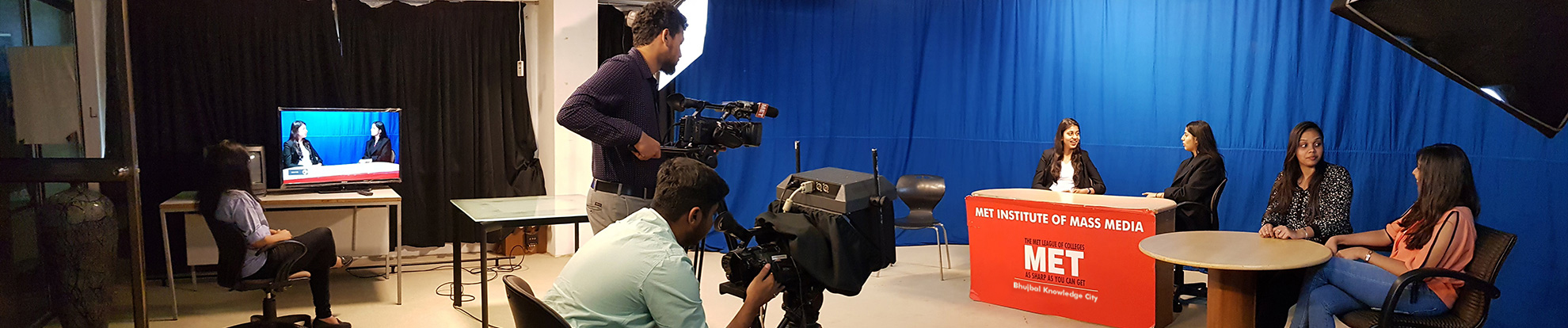
The faculty comprises of qualified professionals who have years of experience in their respective fields. Winners who will mentor you with the conviction that comes from the confidence of having been there and done that. They will pepper their lectures with real life anecdotes, dissect case studies, sharpen your craft and business skills and teach you all the tricks of the trade. You will learn the lessons of life from hands that have been dirtied and feet that have done the walking in the profession.
Prominent TV/Film producers, directors, writers, eminent advertising & media personalities share 'real work life experience' with students. The mentors include professionals from top organisations like Percept Pictures, Disney Channel V, Ogilvy, JWT, Zoom, Mid-Day, Leo Burnett, Hungama, Redifussion Y&R, Network 18, Red FM, Zee TV, Cadbury India, MSL Group, CNBC Awaaz, All India Radio and Star TV, Publicis Beehive & Times Television Network amongst others.
 Dr. Priya Menon Nair
Director, MET Institute of Mass Media
Ph.D. (Consumer Behaviour), M.A. (Psychology), PGDM (Marketing), B.Com, Autism & ADHD Coach
Dr. Priya Menon Nair is an entrepreneurial leader, institution builder, and marketing enthusiast whose career spans corporate training, the founding of a distinctive school of Branding and Advertising, and Agency-M. Known for her persistence, integrity, humility, adaptability, and collaborative approach, she worked closely for over two decades with Mr. Prahlad Kakar, the legendary advertising guru, gaining deep expertise in branding, advertising, ad filmmaking, and production, while cultivating a network of eminent professionals across advertising, sports, and business.
Dr. Nair’s entrepreneurial journey began with a corporate training venture specialising in behavioural skills, leadership development, and CEO coaching. She has successfully executed high-profile projects for leading MNCs such as Infosys, SAP, Wipro, Godrej, Dell, Siemens, Deloitte, Cap Gemini, Volkswagen, and JP Morgan, and curated thematic corporate events featuring international cricketers, writers, entrepreneurs, corporate leaders, artists, and filmmakers.
Academically accomplished with a PhD in Management (Consumer Behaviour), dual Master’s degrees in Psychology and Business Administration, and a Project Management Professional (PMP) certification, Dr. Nair is also an internationally certified ADHD and Autism Coach, dedicated to supporting individuals with diverse needs. As COO of The Miles SOBA and co-founder of PKSBE, she has pioneered educational innovations, including India’s first bachelor’s program in branding and advertising, launched in collaboration with NMIMS, Mumbai, and has established partnerships with over 12 universities nationwide, including IIM Indore.
Currently serving as Director at MET Institute of Mass Media, Dr. Nair is reimagining media education by integrating experiential learning, strategic initiatives, and value-driven pedagogy. She inspires students through practical learning, life lessons, and hands-on projects, driven by a vision to make MET's IMM the leading institute in India, bridging the gap between academia and industry, empowering students with creativity, strategic thinking, ethical grounding, and a mindset to innovate and lead confidently in the media world.
 Mr. Mahesh Chauhan
Founder Director -Salt Brand Solutions
B.Tech -IIT Bombay
 Mr. Bobby Pawar
Former Chairman and CCO – Havas Media Group
 Dr. Yogesh Dhanjani
Associate Professor
MET Institute of Mass Media
PhD (Journalism and Mass Communication) · MA (Psychology) · MA (Communication and Journalism) · UGC MAH SET · BMM · Cert-ET (British Council) · Executive Programme in Martech and AI, MICA
Dr. Yogesh Dhanjani is an accomplished media academic, award-winning journalist, researcher, and institutional leader with over fourteen years of experience at the intersection of media, psychology, technology, and society. His professional journey reflects a distinctive combination of journalistic credibility, academic rigour, strategic thinking, and a deep commitment to developing future-ready communication professionals.
At MET Institute of Mass Media, he contributes to academic leadership by spearheading Learning and Development, Assessments, and Compliance, strengthening the quality, relevance, and effectiveness of academic delivery. His work focuses on building meaningful learning experiences, advancing assessment practices, aligning academic processes with institutional standards, curriculum integration with AI and bridging the gap between classroom learning and industry expectations. As an educator and mentor, he champions experiential learning, critical inquiry, innovation, and the integration of emerging technologies into media education.
His career began with The Times of India, where his work earned him the YO Bureau Award for editorial excellence. Moving beyond reporting, he went on to build a media institution from the ground up. As Founder Faculty and Head of Operations of Acharya 90 FM, he led the journey from licensing to broadcast, helping establish the community radio station as a platform for underrepresented voices and community engagement. His experience spans journalism, media operations, institutional development, and the transformative potential of communication.
A committed scholar, Dr. Dhanjani holds a doctorate in Journalism and Mass Communication, with research focused on social media privacy and digital deception. His research interests explore the psychological, ethical, and social dimensions of digital life, including online self-presentation, digital relationships, domestic abuse, and the often-overlooked issue of male sexual violence. With more than 25 publications and conference presentations, three Best Paper Awards, and the Maa Saraswati Yantra Puruskar to his credit, he brings a research-informed perspective to teaching, curriculum development, and contemporary media discourse.
Recognising that understanding communication requires understanding people, he pursued a second master's degree in Psychology and undertook clinical internships that broadened his perspective on human behaviour, emotional processes, and mental well-being. He is also pursuing an Executive Programme in Martech and AI at MICA, reinforcing his commitment to staying at the forefront of technology-enabled marketing, digital transformation, and the evolving communication landscape.
Beyond academia, Dr. Dhanjani believes education must create opportunity and contribute to society. Through the British Council and The Times of India's Teach India initiative, he trained underprivileged learners in spoken English to improve their confidence and employment prospects. His social engagement extends to NGO initiatives, mental health advocacy through NAMI India, and animal welfare through his longstanding association with the SPCA.
His academic contribution extends to institutional governance and research mentorship. He serves on the Board of Studies at Pillai College as a Vice Chancellor's Nominee and is a member of the Research Advisory Committee at Chhatrapati Shivaji Maharaj University, contributing to academic development and the advancement of research scholarship.
At the heart of his work is a simple conviction: education should not merely prepare students for the world as it exists; it should equip them to shape the world that is emerging. Whether in the newsroom, the classroom, a community radio station, or an academic committee, Dr. Dhanjani brings together curiosity, strategic vision, intellectual rigour, and empathy to create learning that is relevant, responsible, and transformative.
 Mr. Rahul Srivastava
Film Writer, Editor & Director
Rahul Srivastava is a distinguished film editor, director, and writer. He has edited several acclaimed films, including Saheb Biwi Aur Gangster and Bullett Raja. As a director, he has helmed more than 200 advertising films, showcasing a keen eye for visual storytelling. His short film Itwaar, which he both wrote and directed, earned the Filmfare Award for Best Performance. Beyond cinema, Rahul is also an active voice in literature — his book Pui has been widely appreciated by readers. Alongside his creative pursuits, he contributes to academia as a member of the Board of Studies at several universities and serves as a visiting faculty member for film studies at various institutions.
Achievements -
1. TVCs Directed
https://vimeo.com/rahuldadda
2. Short film ITWAAR won the Best Actor Filmfare
https://www.youtube.com/watch?v=xm1fnTVyVxI
3. Films Edited
https://www.imdb.com/name/nm2103331
4. Books Authored
https://www.amazon.in/Pui-Rahul-Srivastava/dp/811999664X
 Mr. Yusuf Shaikh
Founder & CEO – ANTA CINEMA, a brand of Yen Movie Studios Pvt. Ltd.
Yusuf Shaikh is the Founder & CEO of Janta Cinema, Express Cinemas, and Cinema 99, with over three decades of expertise in film production, distribution, and exhibition. He has distributed over 200 films, including award-winning titles, and is leading innovative ventures to reinvent cinema experiences. An expert in independent film marketing, theatrical and digital distribution, and brand strategy, he also serves as a consultant, educator, and Vice-Chairman of Media Cell India Business Group, contributing actively to industry bodies like IMPPA and FFI.
 Ms. Rashmi Kaushik
Innovative Education Consultant/ Visiting Faculty
Innovative Education Consultant | Leading Creative Teaching Solutions | Empowering Educators and Students | MET Faculty for 14 Years
 Mr. Rajkamal Pandey
Senior Group Head, Adfactors PR
Rajkamal Pandey is currently serving as Senior Group Head at Adfactors PR, where he has built a remarkable career spanning over 12 years. Rajkamal was a pioneer in establishing the Media Networking team in the MMR region, leading the team for 11.9 years. Presently, he is part of the Corporate SBU, overseeing high-profile corporate brand mandates across sectors including Retail, Real Estate, Gems & Jewellery, and Energy.
 Mr. Parveen Thakur
Digital Media Consultant – Nine dots Technology
Embarked on my journey in 1998, when the internet was a luxury and "going digital" meant owning a fancy CD-ROM. After completing high school with a diploma in Visual Communication, I found myself walking two parallel paths—one in the classroom and the other in the professional world.

Mr. Franco John Patil
DGM – PR & Marketing, Red Dot Representation – Tamarind Global Pvt. Ltd.
DGM - PR & Marketing, Red Dot Representation – Tamarind Global PVT LTD PG in Public Relations and Advertising
 Mr. Shreeraj Nair
Independent Motion Graphics, Design & VFX Trainer - MographNair
Self driven & passionate animation and Visual effects mentor with more than 2 Decades of experience in software training and project delivery. Expertise in training, curricula creation, motion graphics, visual effects amd project supervision . Lives life by the credo of " Evolve, Enrich, Empower."
 Ms. Priyanka Surve
Founding Partner & Creative Director, Motley
Passionate about crafting unforgettable branding and advertising that resonate deeply with audiences. With 15 years of experience in the advertising industry, I've honed my skills in copywriting, creative strategy, and team leadership. As a founding partner of Motley, I'm committed to delivering innovative and impactful creative solutions for brands we work with.
 Mr. Viv Alfred Williams
Director, Creative Director, Executive Producer & Filmmaker
Director, Creative Director, Executive Producer, Filmmaker, into Ads, Corporate AV's, Travel shows, Shorts, Music videos, Documentaries, Brand films, Event films, Digital films, CSR films etc.
 Ms. Althea Shah
Marketing, PR & Events Professional
Althea Shah handles projects providing Marketing solutions and services, including Advertising, Media, Entertainment & Events She has over 20 years’ experience, encompassing strategic planning, qualitative & quantitative research, interactive marketing, creative development, media planning & buying, database /direct-marketing, public relations, sales promotion and visual merchandising, corporate positioning, product launches, online strategies, events, intellectual properties & business development strategies.
 Mr. Anish Sarai
Professional Photographer & Cinematographer – Nykaa, Vogue.in
Portrait Photography • Commercial Photography • Videography
 Mr. Sandeep Shaminami
Sr. Manager AVOD - AHA
Networking’ are the two words that define me. I carry an experience in Ad Sales, Sponsorship Sales, Brand Solutions & Business Development with a market reach in various brand categories ie; BFSI, Health & Pharma, Automobiles, Real Estate, FMCG, IT & Technology.
 Ms. Nirzari Bhide
Business Professional
Business Professional with an entrepreneurial approach |Visiting Faculty Continuous Learning mind-set| Passion for Performing arts|

Ms. Kalpana Rane
Feature Editor, Dainik Saamana
Diploma in Journalism & Communications Skills
A journalist with more than 12 years experience in the media industry
 Mr. Vishal Khanna
Career Coach & Mentor
 Mr. Suhail Tatari
Director

Mr. Shikhar Bhatnagar
Immersive Filmmaker, CEO - Aayushi Fulldome Films, MD - Aeon Immersive Pvt. Ltd.
 Mr. Ali Khan
Founder, Prachand Entertainment

Dr. Omprakash Mandge
Academic Leader | I/C Principal | AI Expert
PhD | 22+ Years in Higher Education | ML, Data Science, Faculty Development
 Mr. Nitin Patil
Course Co-ordinator, MET IIT
 Mr. Arghya Saha
Director - Business Growth & Planning Impact Communication


©Mumbai Educational Trust, All rights reserved | Last Modified Date: Wednesday, October 28th, 2026
